The Bridge That Hummed Itself to Death: What Galloping Gertie Taught the World About Ignoring Music
Opening Day Was Supposed to Be the Hard Part
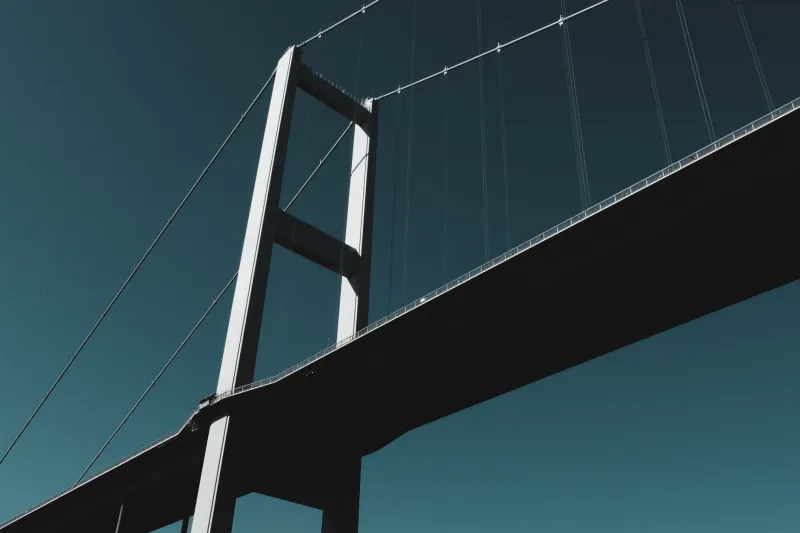
When the Tacoma Narrows Bridge opened on July 1, 1940, it was the third-longest suspension bridge in the world. It connected the city of Tacoma, Washington to the Kitsap Peninsula across the Puget Sound, and it had cost $6.4 million — serious money in 1940 — and represented what was then considered a triumph of streamlined, modern bridge design. The engineering team had built it slender and elegant, shaving weight and material costs by using solid plate girders instead of the open-truss design that most large suspension bridges of the era employed.
 Photo: Puget Sound, via i.pinimg.com
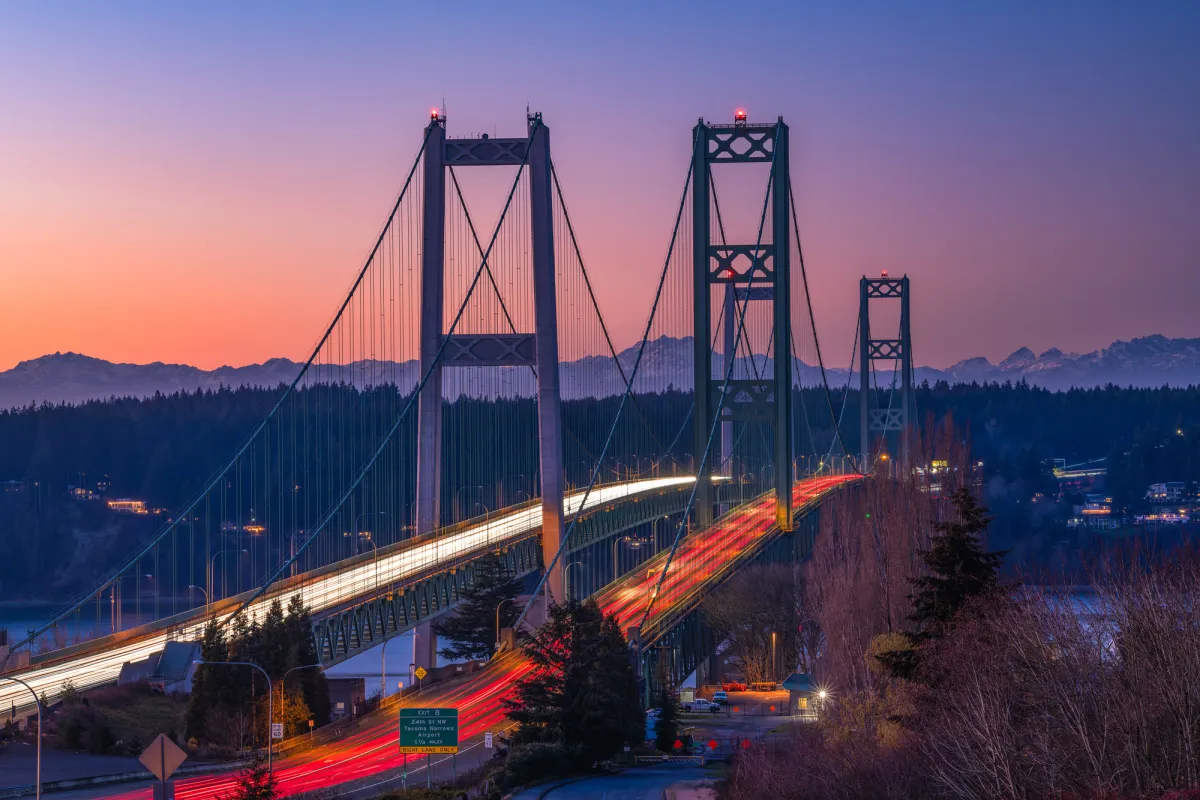 Photo: Tacoma Narrows Bridge, via www.craiggoodwinphoto.com
Almost immediately, drivers noticed something odd. The bridge moved. Not in the alarming, catastrophic sense — not yet — but in a rhythmic, rolling wave that earned it a nickname within weeks of opening: Galloping Gertie. Some drivers reportedly felt carsick crossing it. Others made special trips just to experience the sensation. A few local thrill-seekers would drive across repeatedly on windy days, treating the oscillation like a carnival ride.
Engineers were aware of the movement. They were, by most accounts, not particularly worried about it.
They were wrong.
November 7, 1940: Forty Miles Per Hour and a Fatal Frequency
The morning the bridge died was not a storm. That's the part people often get wrong when they hear this story for the first time. The wind that destroyed the Tacoma Narrows Bridge was blowing at roughly 40 miles per hour — a stiff breeze, certainly, but nothing close to the extreme conditions the structure had been designed to withstand. The bridge had been tested against theoretical wind loads far more severe than what hit it that morning.
The problem wasn't the wind's strength. It was its timing.
As the wind pushed against the bridge's solid plate girders, it created vortices — spiraling pockets of air that shed off the structure's edges in a rhythmic pattern. By a catastrophic coincidence of geometry and physics, the frequency at which those vortices shed matched the bridge's own natural oscillation frequency almost exactly. This phenomenon, called aeroelastic flutter, meant that each gust wasn't fighting the bridge — it was feeding it. The bridge absorbed the energy of the wind and converted it into increasingly violent motion, the way a wine glass shatters when a singer hits precisely the right note.
Every musician understands resonance. Every physicist understands it. The engineers who designed Galloping Gertie had, in their calculations, essentially left it out.
By 10 a.m., the bridge was twisting violently along its entire length. By 11:02 a.m., it was gone.
The Professor Who Kept Filming
Barton Farquharson, a University of Washington engineering professor, had been monitoring the bridge for months. On November 7th, he was on site when the oscillations became severe. He filmed what he could.
Also on the bridge that morning was Leonard Coatsworth, a local newspaper editor who had driven onto the span before the situation became critical. His car — with his daughter's dog still inside — was abandoned on the deck as the twisting became too violent to stand on. The dog, a cocker spaniel named Tubby, did not survive. Coatsworth himself crawled off the bridge on his hands and knees, clinging to the railing as the roadway pitched beneath him.
But the most consequential person present that morning was Barton Elliott, a local amateur filmmaker and film studies instructor who had been drawn to the bridge by the spectacle of its movement. He kept his camera running through the entire collapse, capturing 16mm footage of the structure writhing, fracturing, and finally plunging into Puget Sound in enormous sections.
 Photo: Barton Elliott, via res.sanbuy.com
That footage became something extraordinary.
The Most Important Accident in Engineering Education
Within years, the Tacoma Narrows collapse film was being shown in university engineering programs across the country. Within decades, it was arguably the single most viewed piece of engineering failure footage in history. It is still shown today in physics and civil engineering classrooms because it illustrates resonance and aeroelastic flutter with a visceral clarity that no textbook diagram can replicate.
The irony is almost too neat: a bridge that engineers built while overlooking a fundamental principle of physics was destroyed in a way that perfectly demonstrated that principle on film, accidentally creating the definitive teaching tool for the very concept they had missed.
The collapse triggered a complete rethinking of suspension bridge aerodynamics worldwide. Every major bridge built after 1940 was wind-tunnel tested. Open-truss stiffening girders became standard. The slender, elegant profiles that had been fashionable in the late 1930s gave way to designs that explicitly accounted for how air would flow around and through the structure.
Galloping Gertie killed no human beings — a remarkable fact given the violence of its collapse. But it fundamentally changed how bridges are designed, and it did so by failing in the most visible, most documented, and most teachable way possible.
The Bridge Beneath the Bridge
The wreckage of the original Tacoma Narrows Bridge still lies on the floor of Puget Sound, where it has become an artificial reef. A replacement bridge opened in 1950, designed with the lessons of its predecessor explicitly built in. A second parallel span opened in 2007.
Drivers cross the sound today without thinking about resonance or vortex shedding or the morning a moderately windy November day brought down a structure that was supposed to last a century. The physics hasn't changed. The engineers, finally, have.