From Pub Crawl to Patriotism: How Britain's Favorite Drinking Tune Became America's Sacred Anthem
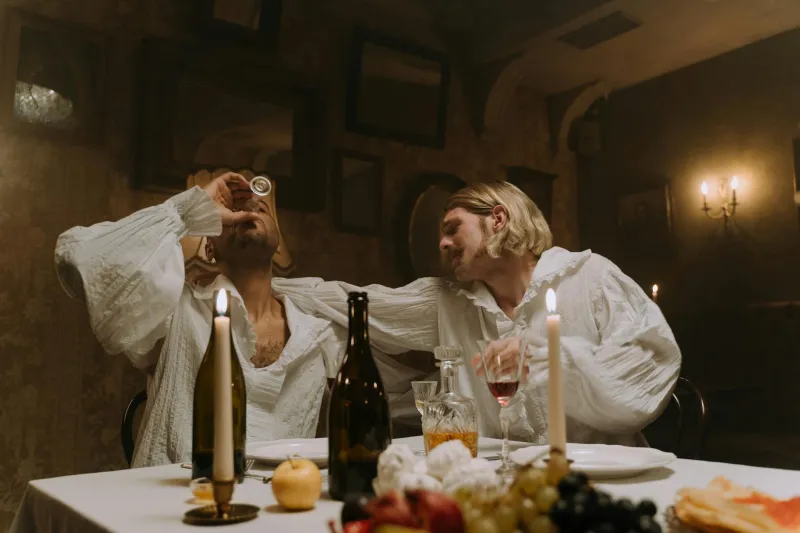
Picture this: you're belting out the national anthem at a baseball game, hand over heart, voice cracking on those impossible high notes. Now imagine that same melody echoing through a smoky London tavern in 1775, sung by drunk British gentlemen celebrating wine, women, and the Greek god of parties.
Welcome to the utterly ridiculous origin story of "The Star-Spangled Banner."
The Boozy British Beginning
Long before Francis Scott Key penned his famous verses about rockets and ramparts, the melody we now associate with American patriotism was the unofficial theme song of the Anacreontic Society, an exclusive London gentlemen's club dedicated to music, poetry, and getting absolutely hammered.
 Photo: Francis Scott Key, via images.mgpd.de
The original song, "To Anacreon in Heaven," was written around 1775 by composer John Stafford Smith. Its lyrics celebrated Anacreon, the ancient Greek poet known for his odes to wine and love. The chorus went something like: "And besides I'll instruct you like me to entwine / The myrtle of Venus with Bacchus's vine."
 Photo: John Stafford Smith, via cdn.britannica.com
Translation: let's get drunk and find some romance.
Every meeting of the Anacreontic Society began with members standing and belting out this tune, which required serious vocal gymnasatics to hit those soaring high notes. It was basically the 18th-century equivalent of "Sweet Caroline" at a Red Sox game, except with more references to Roman gods and significantly more wine.
An American Poet's Midnight Inspiration
Fast-forward to September 14, 1814. Francis Scott Key, a 35-year-old lawyer and amateur poet, found himself aboard a British ship in Baltimore Harbor, negotiating the release of American prisoners during the War of 1812. As dawn broke, he witnessed the massive American flag still flying over Fort McHenry after a brutal 25-hour bombardment.
Inspired by the sight, Key scribbled down a poem on the back of a letter. But here's where it gets weird: when it came time to set his words to music, Key didn't compose an original melody. Instead, he chose the tune of that British drinking song he'd heard performed at social gatherings.
Think about the irony for a second. Key was celebrating America's resilience against British attack by using a melody that British gentlemen had been drunkenly singing for decades. It's like writing an anti-McDonald's protest song to the tune of "I'm Lovin' It."
The Long Road to Official Status
Key's song, originally titled "Defence of Fort M'Henry," became popular almost immediately. But it took 117 years to become our official national anthem, and the journey was anything but smooth.
For most of the 19th century, America didn't have an official national anthem at all. Different songs filled the role at different times. "Hail, Columbia" was popular for a while. "My Country, 'Tis of Thee" had its moment (though it used the same melody as "God Save the Queen," creating another awkward British connection).
"The Star-Spangled Banner" gradually gained traction, especially among military bands who appreciated its dramatic flair. But many Americans found it problematic. The melody was notoriously difficult to sing – those high notes that worked fine for tipsy British club members proved torture for average Americans trying to sing along at public events.
Congress Nearly Chose Something Else Entirely
By the early 1900s, pressure mounted for an official decision. Multiple bills were introduced in Congress proposing different songs. "America the Beautiful" had strong support – it was easier to sing and didn't reference bombs bursting in air. "The Battle Hymn of the Republic" was another contender.
In 1929, a House committee held hearings on the matter. Representatives seriously debated whether Americans should be expected to sing a melody that required professional-level vocal range. Some suggested commissioning an entirely new song with a more manageable tune.
But tradition won out. On March 3, 1931, President Herbert Hoover signed a resolution making "The Star-Spangled Banner" the official national anthem of the United States.
The Irony That Keeps on Giving
So every time Americans stand for the national anthem, we're essentially performing a British drinking song about pagan gods, repurposed by a lawyer who witnessed a military battle, officially adopted during the Great Depression after decades of congressional hemming and hawing.
The melody that once encouraged London gentlemen to "entwine the myrtle of Venus with Bacchus's vine" now accompanies solemn moments of American patriotism. Francis Scott Key's words about "the land of the free and the home of the brave" are sung to a tune originally designed to celebrate getting drunk and chasing romance.
It's perhaps the most accidentally American story ever: taking something British, repurposing it for our own dramatic moment, arguing about it for over a century, and finally making it official just because we'd been doing it that way for so long.
The next time you're struggling to hit that high note on "free," remember: you're not just singing the national anthem. You're participating in a musical tradition that started in a London tavern with a bunch of drunk guys singing about wine and women. If that's not the most perfectly absurd origin story for American patriotism, nothing is.