Pack Up the Pews: The Wyoming Town That Picked Up and Moved, Then Vanished from Every Map for Fifty Years
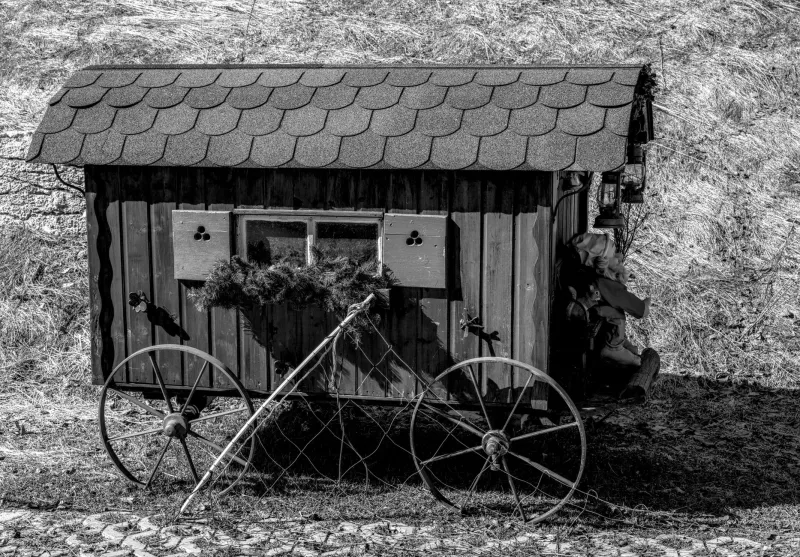
There are towns that die. There are towns that grow. And then, in a remote stretch of Wyoming scrubland in the early 1920s, there was a town that simply decided it was in the wrong place — and moved.
Not metaphorically. Not gradually. The residents of the community then known as Carbide Flats loaded their homes onto flatbed wagons, hitched their church to a team of draft horses, and relocated the entire settlement approximately five miles to the southwest over the course of a single long weekend. They left behind a name, a post office, and almost all of the paperwork that would have allowed the government to find them again.
For the next fifty years, the town — now calling itself something slightly different, operating under informal local governance, and served by a new railroad stop — existed in a kind of official limbo. It was real. Its residents paid taxes, sent children to school, and buried their dead. But on federal maps, in state directories, and in the census records that were supposed to account for every soul in the territory, it simply wasn't there.
Why a Town Moves
To understand why Carbide Flats relocated, you have to understand what a railroad meant to a small Wyoming community in the 1920s.
A railroad stop was not a convenience. It was the difference between economic viability and slow strangulation. Goods came in by rail. Crops and livestock went out by rail. A town without a stop was a town on borrowed time.
Carbide Flats had a stop — or rather, it had been promised one. When a regional rail line extended its route through the area in the late 1910s, local landowners had negotiated what they understood to be an agreement: a depot would be built within reasonable distance of the existing settlement. What the railroad built instead was a loading platform five miles away, on a parcel of land the company already owned and had no interest in moving.
The railroad's position was simple: the platform was where it was. If the town wanted access, the town was welcome to come closer.
After two years of fruitless negotiation, the residents of Carbide Flats made a decision that would have seemed insane anywhere else. They agreed with the railroad. They would come closer.
The Weekend Everything Moved
The relocation happened across three days in late September of 1923, according to accounts preserved in the Wyoming State Archives and in the handwritten journals of a local schoolteacher named Vera Osgood.
Residents had spent the preceding weeks preparing — jacking up wooden-framed homes onto log rollers, disassembling the more fragile structures and rebuilding them at the new site, negotiating with neighboring ranchers for right of passage across the intervening land. The community's single church, a modest wood-frame building with a small bell tower, was moved in one piece, pulled by six draft horses and guided by a crew of twelve men who spent most of the journey arguing about the best line through a particularly uneven stretch of ground.
By Sunday evening, the community had reassembled itself around the new railroad stop. Someone hung a hand-lettered sign. Someone else started a fire in the relocated general store's stove. Life resumed.
What did not resume, in any organized fashion, was the town's relationship with official bureaucracy.
The Paperwork That Never Followed
Here is where the story gets strange in a different way.
Carbide Flats, as a named settlement, remained on state maps at its original location — because no one had formally notified the relevant authorities that it had moved. The new settlement, now operating under a slightly different informal name that residents had adopted almost by accident, was never officially registered as a new community. It had no incorporation documents, no formal charter, and — crucially — no entry in the state's official directory of populated places.
For census purposes, residents listed their location using a combination of the new railroad stop's name and their rural route numbers. The census bureau, working from existing maps, assigned those returns to a different existing settlement several counties over. For fifty years, a functioning Wyoming community was, in the eyes of the federal government, a statistical ghost distributed across several other places that had nothing to do with it.
The confusion was only fully unraveled in the 1970s, when a graduate student studying rural population shifts in the Mountain West noticed a persistent discrepancy between railroad records, tax filings, and census data for a particular stretch of Wyoming. The investigation that followed took three years and involved the cooperation of the Wyoming State Archives, the Bureau of the Census, and a retired postmaster who turned out to be the granddaughter of one of the original residents who had pulled the church across the scrubland in 1923.
What the Story Actually Tells Us
The relocation of Carbide Flats is funny, in a dry, Wyoming kind of way. But it's also a remarkably clear illustration of how official reality and lived reality can diverge — and stay diverged — for an astonishingly long time.
The town existed. Its people were real. They paid taxes and had children and built a community that functioned for decades. But because the paperwork didn't follow the buildings, the government's version of that community was frozen in place five miles away, slowly becoming a fiction that no one had the specific job of correcting.
The residents, for their part, seem to have been largely unbothered. When the graduate student finally made contact with the community in the early 1970s and explained that they had technically been invisible to the federal government for half a century, the reaction — according to her published account — was something between amusement and mild pride.
They had moved an entire town with draft horses and determination. The paperwork, one resident reportedly said, could catch up when it was ready.