A $0.25 Late Fee That Followed Her for Three Decades: The Librarian the FBI Never Forgot
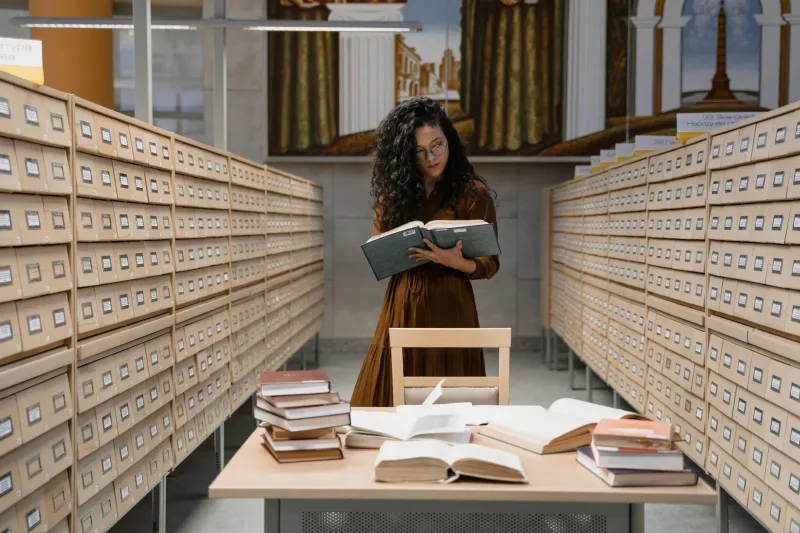
There are bureaucratic nightmares, and then there is the story of Dorothy Canfield — a soft-spoken small-town librarian from rural Ohio who spent the better part of three decades trying to convince the federal government that she was not, in fact, a fugitive.
The whole thing started with a library book.
The Fine That Started It All
In the spring of 1971, Dorothy checked out a copy of a popular gardening reference guide from the county library where she also happened to work. She returned it eleven days late. The fine was twenty-five cents. She paid it — or at least, she was almost certain she paid it — and moved on with her life.
She had no reason to think about it again. And for years, she didn't.
Dorothy kept her head down, catalogued thousands of books, helped generations of kids find their first novels, and retired quietly in 1998. She was sixty-three years old, planning a trip to visit her sister in New Mexico, and had every reason to believe her legal record was as clean as her reading habits.
Then she tried to renew her passport.
The Government Had Questions
The rejection letter was polite but baffling. There was, it said, a flag on her record. A matter of an outstanding warrant. Dorothy assumed it was a clerical error — the kind of thing you clear up with one phone call and a little patience.
It was not that kind of thing.
What investigators eventually pieced together was a chain of administrative failures so absurd it reads like a Kafka novel adapted for a government training video. When Dorothy's original fine had been processed in 1971, a data entry clerk had misrecorded the payment as incomplete. In 1974, when the county library system migrated to a new records platform, that incomplete payment entry was flagged as a delinquent account. Standard procedure transferred delinquent accounts to a collections database shared with the county sheriff's office.
So far, mildly inconvenient. But then came the twist.
When One Error Becomes Many
In 1979, a woman in a neighboring county was arrested for check fraud under the name Doris Canfield — close enough to Dorothy's name that an overworked clerk, cross-referencing a shared regional database, merged the two files. Doris's criminal record became attached to Dorothy's delinquent library account. The merged file then propagated through successive database migrations in 1983, 1991, and again in 1996, each time gaining a little more official weight.
By the time Dorothy sat down to renew her passport in 1998, her file described a woman with an unpaid debt to the state, a prior fraud charge, and — because of a separate clerical error no one could fully trace — an open warrant from a county she had never set foot in.
Dorothy was, on paper, a career criminal. In reality, she had spent the last twenty-seven years recommending biographies and shushing teenagers.
Thirty Years of Fighting a Ghost
What followed was not a quick fix. It was a decade-long legal odyssey that required Dorothy to hire two separate attorneys, file paperwork in three counties, appear before a federal administrative judge, and obtain sworn affidavits from former colleagues confirming she had been physically present at the library on dates when her file claimed she was elsewhere committing fraud.
At one point, the original Doris Canfield — the actual check fraud convict, long since released — had to be tracked down and interviewed to confirm that she and Dorothy were, in fact, two different human beings.
The warrant was finally vacated in 2001. The merged file was officially separated in 2004. The last residual flag on Dorothy's passport record was cleared in 2006 — thirty-five years after she returned a gardening book eleven days late.
She never did make it to New Mexico to visit her sister. Her sister passed away in 2002.
The Gaps That Made It Possible
Dorothy's story isn't just a quirky anecdote. It's a window into the invisible machinery of government recordkeeping — a system built on the assumption that data entered correctly once will remain correct forever, and that human error is an exception rather than a constant.
Legal scholars who have studied similar cases point to a structural problem: older databases were rarely designed with error-correction in mind. Once a flag entered the system, it didn't just sit there. It replicated. It gained credibility through repetition. By the time anyone questioned it, the original source had been buried under so many layers of migration and re-entry that tracing it back was like trying to find the first domino after the whole row had already fallen.
Dorothy, for her part, remained remarkably calm about the whole affair. When a local reporter asked her how she felt after the final flag was cleared in 2006, she reportedly said she was mostly relieved, but also a little amused.
"I always told patrons," she said, "that the library keeps very good records."
Apparently, it does. For better or for worse.