The Hurricane That Showed Up to Court: The Storm That Literally Moved a Property Line Mid-Trial
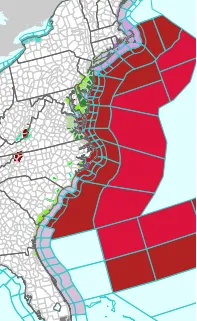
Photo: US National Weather Service, Public domain, via Wikimedia Commons
Legal disputes over property lines are among the most tedious conflicts known to civilization. Neighbors measuring inches with tape measures. Surveyors testifying about benchmarks. Attorneys arguing over language in documents written before anyone involved was born.
And then, occasionally, a hurricane shows up and makes everyone's argument irrelevant.
A Dispute Built on Sand — Literally
Coastal property law has always been a little precarious, and not just metaphorically. When your property sits next to an ocean, a bay, or a major waterway, you're dealing with a boundary that the water itself has opinions about.
American property law has a surprisingly sophisticated vocabulary for this problem. There's accretion — the gradual, almost imperceptible addition of land as sediment accumulates — and avulsion, which is the sudden, dramatic relocation of land caused by a flood, a storm, or a river deciding to take a different route. The legal distinction matters enormously: under most state laws, land gained through slow accretion belongs to the adjacent property owner, but land relocated through sudden avulsion doesn't change ownership — the original boundary line stays where it was, regardless of where the actual dirt ended up.
This sounds like a sensible rule until you try to enforce it after a major storm has rearranged the coastline and nobody can agree on where "where it was" actually was.
Enter the Hurricane
The case in question had all the hallmarks of a standard coastal property dispute: two parties, one contested boundary, competing surveys, and attorneys billing by the hour. The disputed land — a strip of coastal property whose exact dimensions depended heavily on which survey you trusted — had been the subject of litigation for months before the storm season arrived.
Then a hurricane made landfall and deposited the problem squarely in the category of "things nobody had adequately prepared for."
The storm physically moved land. Not metaphorically, not through erosion measured in millimeters per year — actually moved it. The coastal geography that both parties had been arguing about in court looked meaningfully different after the storm than it had before. The boundary markers were either relocated, destroyed, or rendered irrelevant by the fact that the land they were marking had migrated.
The attorneys, to their credit, adapted. The arguments, less so.
What Do You Do When Evidence Moves?
The legal question the storm created was almost elegant in its absurdity: if a piece of disputed property physically relocates during an active lawsuit, which version of the property are you adjudicating?
The defendant argued, reasonably, that the storm's relocation of the land was classic avulsion — sudden, dramatic, legally irrelevant to ownership. The original boundary line should hold, regardless of where the sediment had wandered.
The plaintiff's position was more creative: the storm hadn't just moved land, it had fundamentally altered the conditions that made the original boundary meaningful in the first place. You couldn't apply pre-storm survey data to post-storm geography as if nothing had happened.
Both arguments had merit. Neither argument had a clean precedent. The court was navigating genuinely uncharted territory — which, given that the actual territory had just been rearranged by a Category storm, felt appropriately on-brand.
The Ruling Nobody Expected to Need
What emerged from the case was a legal framework that courts in storm-prone states have been citing ever since. The ruling had to address a stack of questions simultaneously: the avulsion doctrine, the evidentiary status of pre-storm surveys, the question of which party bore the burden of proof when the physical evidence had been relocated by an act of God, and the genuinely thorny issue of whether the storm constituted an intervening event that altered the legal landscape (in the most literal possible sense).
The decision didn't please everyone — property law decisions almost never do — but it established something important: when nature intervenes dramatically in a property dispute, courts cannot simply pretend the intervention didn't happen. The physical reality of the land matters, even when it complicates the legal theory.
For coastal property owners, this was both reassuring and terrifying. Reassuring because it meant courts would engage with post-storm reality rather than clinging to outdated surveys. Terrifying because it meant that any sufficiently powerful storm could, in principle, reopen a settled property question.
The Broader Lesson the Gulf Coast Keeps Teaching
This story isn't just a legal curiosity. It's a preview of an argument that American courts are going to be having with increasing frequency as sea levels rise and storm intensity increases. The avulsion doctrine was written for a world where dramatic coastal changes were rare. It was not written for a world where they're a regular feature of hurricane season.
Property law moves slowly. Hurricanes do not. The gap between those two speeds is where cases like this one live — and where some very expensive legal arguments are still waiting to happen.
The attorney who lost the case to a hurricane didn't lose because of bad lawyering. He lost because his opponent had a better argument, and also because the Gulf of Mexico showed up as an uninvited witness and rearranged the exhibits.
In the annals of American litigation, it remains one of the more dramatic evidentiary developments on record.