Buried in the Wrong Grave: The Mix-Up That Ended a Mountain Feud Nobody Could Forget
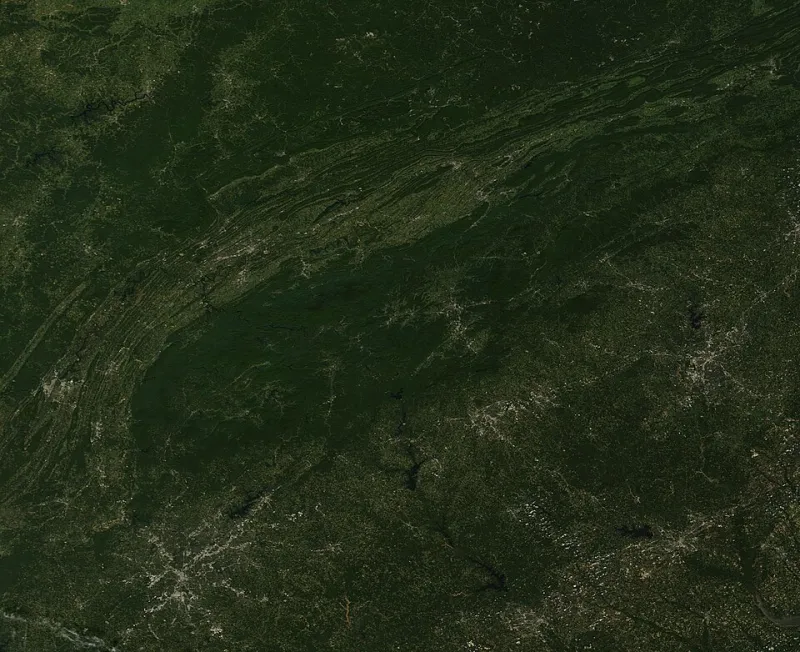
Photo: MODIS Land Rapid Response Team, NASA GSFC, Public domain, via Wikimedia Commons
Appalachian feuds have a mythology all their own. The Hatfields and McCoys made it into the history books, but for every famous rivalry that got newspaper coverage, there were dozens of quieter, equally bitter disputes playing out in the hollows and ridge lines of the mountain South — passed down through families like heirlooms, maintained with a stubbornness that outlasted the original grievance by generations.
 Photo: Hatfields and McCoys, via static1.simpleflyingimages.com
The feud between the Calhoun and Draper families of eastern Kentucky was one of those. It had started, as best anyone could reconstruct it, sometime in the 1850s over a disputed property line and a missing hog. By the 1890s, the original hog was long gone and so were most of the people who'd argued about it, but the animosity had calcified into something structural. Calhouns didn't speak to Drapers. Drapers didn't attend the same church as Calhouns. Children were taught early who the enemy was, even if they couldn't quite explain why.
What ended it wasn't a peace negotiation or a marriage between the families or a shared tragedy. It was a clerical error in a funeral parlor.
Two Deaths, One Very Bad Week
In the winter of 1897, both families suffered losses within days of each other. Elias Calhoun, an elderly patriarch, died of pneumonia sometime in late January. Three days later, Harmon Draper — also elderly, also a family figurehead — followed him. The deaths were unrelated. The timing was not.
Both bodies were taken to the same funeral establishment in the nearest town with such a facility, a modest operation run by a man named Roscoe Finley who handled most of the region's death-related paperwork alongside a single assistant. Finley was, by all accounts, competent but overworked. Two bodies arriving from feuding families in the same week, during winter when roads were bad and record-keeping was done by hand in ledgers that were not always legible, was exactly the kind of situation where small errors compounded into large ones.
Somewhere in the preparation process, the bodies were switched.
Elias Calhoun was delivered to the Draper family. Harmon Draper was delivered to the Calhouns. Both families, receiving the body of a similarly aged man in a pine box during a season of grief and cold, conducted their funerals without suspicion. The Calhouns buried Harmon Draper in their family plot with full honors and genuine mourning. The Drapers buried Elias Calhoun in theirs.
The Weight of Shared Grief
What happened next is the part of this story that feels almost too neat to be real, except that the evidence suggests it genuinely unfolded this way.
Both families, in the weeks following their respective funerals, experienced something unexpected. Neighbors who attended both services noted later that the grief on each side had seemed unusually tender — more open, somehow, than the guarded stoicism these families typically displayed. There's a reasonable psychological explanation for this: when you bury someone surrounded by people who loved the same person, the shared loss creates a momentary dissolution of social barriers. Both clans had, without knowing it, mourned together in the most intimate way possible. They had wept over the same man.
Local church records from the period — preserved at a county historical archive — document several interactions between Calhoun and Draper family members in the spring of 1898 that would have been unthinkable the year before. A Calhoun son helped a Draper neighbor repair a fence after a storm. A Draper daughter was recorded as attending a Calhoun wedding. Nothing dramatic. Just the ordinary social contact that had been off-limits for forty years, quietly resuming.
When the Truth Surfaced
Finley apparently realized his mistake sometime in March of 1898, likely when settling his records and finding the documentation didn't align. According to a secondhand account recorded decades later by a local historian, he approached representatives of both families privately, separately, and confessed what had happened.
The response from both families was, by all accounts, the same: silence, then a long pause, then something to the effect of let it be.
Neither family wanted the bodies exhumed. Neither wanted the official records corrected. The graves had been tended. The grief had been real. Undoing it felt, to both clans, like a desecration of something that had already been made sacred — even if accidentally.
The courthouse records from that period show no legal action filed by either family against Finley. No complaints, no demands, nothing. For a region where disputes routinely ended up in court over far smaller matters, that silence is its own kind of document.
What Folklore Does With Accidents
The story circulated in the community for years as a kind of local legend, the kind of thing older residents would tell younger ones as an example of how life sometimes corrects itself by means you'd never plan. It appears in at least two separate collections of Appalachian oral history compiled in the mid-20th century, attributed to different counties but sharing the same essential details — which is either evidence of a widespread pattern or, more likely, evidence that this particular story traveled.
What makes it remarkable isn't the mix-up itself. Funeral errors, while uncommon, have happened throughout history. What's remarkable is the outcome: that two families who had spent four decades in active, inherited hostility needed only to unknowingly share grief to remember that the people on the other side of the feud were, in fact, just people.
They didn't need a mediator. They didn't need a treaty. They needed to cry over the same man without knowing it.
Sometimes the most effective conflict resolution is the kind nobody planned.