Ballot from Beyond: The Dead Voter Who Legally Decided a Mayor's Race
The Vote That Shouldn't Have Counted
In November 1904, the mayoral race in Millbrook, Illinois was so tight that election officials spent three days recounting ballots. When the dust settled, challenger William Hartley had defeated incumbent Mayor Thomas Brennan by exactly one vote. But as officials prepared to certify the results, a disturbing discovery emerged: one of Hartley's votes had been cast by Jacob Reinhart—a man who had died of pneumonia three days before Election Day.
 Photo: Millbrook, Illinois, via images.alltrails.com
What happened next defied all logic and created one of the most bizarre legal precedents in American electoral history.
A Perfectly Legal Ghost
Reinhart had requested an absentee ballot weeks before his death, citing his deteriorating health. He filled it out, had it notarized, and instructed his son to deliver it to the courthouse. The problem? Illinois law in 1904 didn't explicitly require voters to be alive when their ballots were counted—only when they were cast.
When Brennan's campaign challenged the vote, arguing that dead men can't participate in democracy, they discovered something shocking: Reinhart had technically cast his ballot while still breathing. The notarization occurred two days before his death, making it legally valid under existing statutes.
Judge Harrison Mills, presiding over the electoral dispute, found himself in uncharted legal territory. After consulting with state officials and poring over election codes, he reached a conclusion that stunned everyone in the packed courtroom.
"The law requires only that a citizen be alive and competent at the moment of casting their ballot," Mills ruled. "Mr. Reinhart satisfied both conditions. The timing of his subsequent demise, while unfortunate, does not invalidate his constitutional right to participate in this election."
The Town That Elected a Ghost's Choice
The ruling sent shockwaves through Millbrook's 847 residents. Brennan's supporters argued that allowing dead people's votes violated the spirit of democracy, while Hartley's camp insisted that disenfranchising a legally cast ballot would set a dangerous precedent.
Local newspaper editor Samuel Wickham captured the town's bewilderment in an editorial that became widely quoted: "We have witnessed something unprecedented in American politics—a dead man choosing our living mayor. One wonders what Mr. Reinhart would think of his posthumous political influence."
The controversy attracted national attention. Newspapers from Chicago to New York covered the "Millbrook Dead Vote Case," with editorial cartoonists having a field day depicting skeletal hands emerging from graves to drop ballots into boxes.
A Legal Loophole That Changed Everything
The case revealed a glaring oversight in electoral law that existed in dozens of states. Most election codes focused on voter eligibility at registration and ballot casting but said nothing about what happened if voters died before their votes were tallied.
Within months of the Millbrook decision, state legislatures across the country began revising their election statutes. The "Reinhart Rule," as legal scholars dubbed it, required that voters remain alive through the entire electoral process for their ballots to count.
But the changes came too late for Millbrook. William Hartley was sworn in as mayor in December 1904, making him possibly the only American politician who owed his office to a dead constituent.
The Mayor Who Never Forgot
Hartley proved to be an effective leader, serving three terms and overseeing significant infrastructure improvements. But he never forgot the unusual circumstances of his first victory. Every year on the anniversary of Reinhart's death, Hartley would visit the man's grave and leave a small American flag—a tradition he maintained until his own death in 1942.
"Jacob Reinhart believed enough in this town's future to cast what he knew might be his final vote," Hartley said in a 1920 interview. "I've tried to govern in a way that would honor that faith."
The Legacy of the Impossible Vote
The Millbrook case remains a footnote in electoral law textbooks, cited in courses on constitutional interpretation and voting rights. It demonstrated how rapidly evolving democratic institutions could create unexpected legal gaps—and how one small town's bizarre situation could reshape national policy.
Today, every state explicitly requires voters to be alive when their ballots are counted, making Reinhart's posthumous political participation a unique moment in American history. His gravestone in Millbrook Cemetery bears a simple inscription chosen by his family: "Jacob Reinhart, 1847-1904. Citizen to the End."
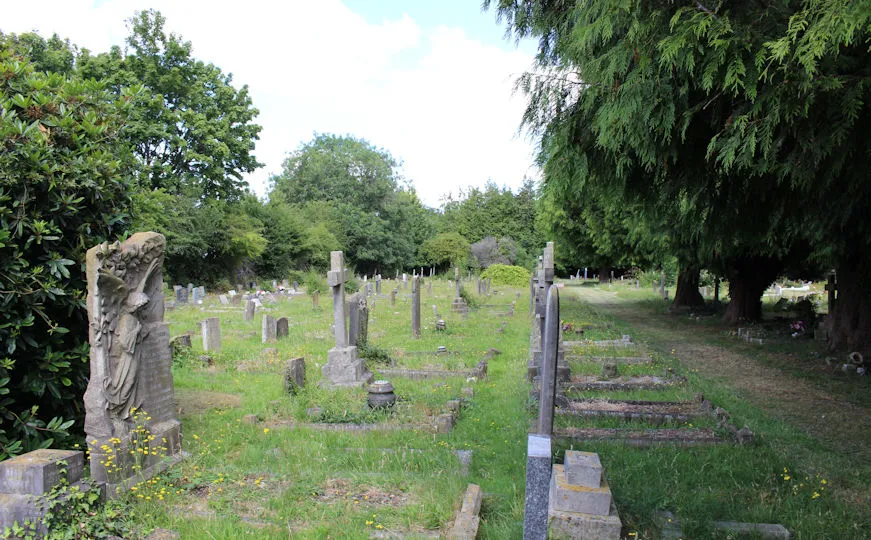 Photo: Millbrook Cemetery, via www.southampton.gov.uk
It's a fitting epitaph for the man whose final act of civic duty created one of democracy's strangest chapters—and proved that sometimes, the most important votes are cast by those who won't live to see their consequences.