When Feathers Defeated Firearms: Australia's Military Humiliation by 20,000 Birds
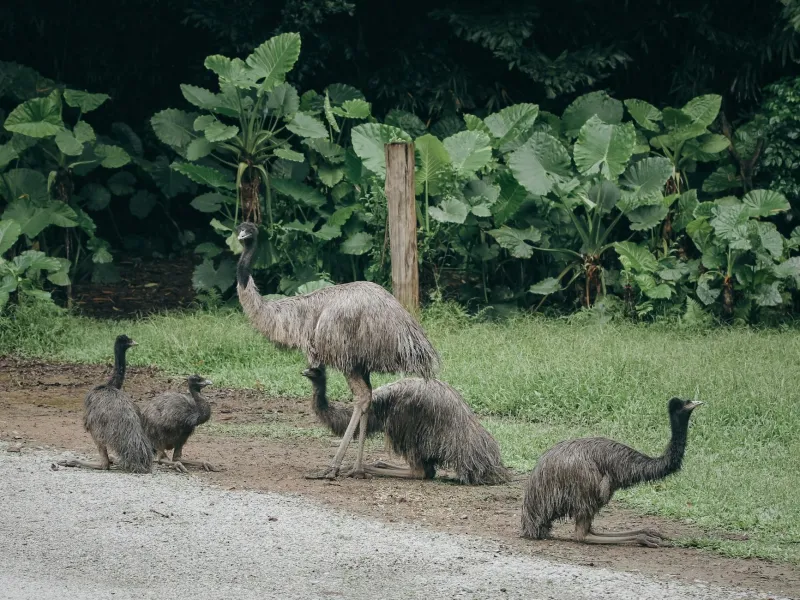
The Enemy: 20,000 Feathered Invaders
Picture this: a modern military deploying machine guns, professional soldiers, and tactical planning against an enemy that can't fly, has no weapons, and communicates primarily through grunting sounds. Now imagine that military losing.
Welcome to the Great Emu War of 1932, when Australia literally declared war on birds—and the birds won.
The conflict began in Western Australia, where drought had driven an estimated 20,000 emus from the interior toward the wheat belt around Campion and Walgoolan. These massive, flightless birds—standing up to six feet tall and weighing 120 pounds—descended on farmland like a living, breathing natural disaster.
Farmers Demand Military Intervention
The emus weren't just passing through. They were systematically destroying crops, trampling fences, and creating gaps that allowed rabbits to pour through and cause additional damage. Wheat farmers, already struggling with post-World War I economic hardship, watched their livelihoods disappear under thousands of three-toed feet.
Local farmers petitioned the government for help. But instead of pest control services or agricultural assistance, they asked for something unprecedented: military intervention.
The Western Australian government agreed, viewing the situation as serious enough to warrant deploying the Royal Australian Artillery. After all, how hard could it be to control some oversized birds?
Operation Emu: Military Planning Meets Reality
On November 2, 1932, Major G.P.W. Meredith arrived in Campion with two soldiers, two Lewis machine guns, and 10,000 rounds of ammunition. The plan was straightforward: locate large groups of emus and eliminate them with overwhelming firepower.
What could go wrong?
Everything, as it turned out.
The first problem became apparent immediately: emus don't behave like enemy soldiers. They don't form convenient target groups, they don't advance in predictable patterns, and they certainly don't stand still when people point weapons at them.
The First Skirmishes
The military's initial engagement occurred when they spotted a group of about 50 emus. The soldiers set up their machine gun and opened fire. The result? A few dead birds and 47 very alert, very fast-moving emus scattering in every direction.
Emus, it turns out, are remarkably difficult to kill with machine gun fire. Their thick feathers provide some protection, and their ability to run up to 30 mph means they can quickly move out of range. More importantly, they're smart enough to learn.
After the first few encounters, the emus began posting sentries. While the main flock fed, lookout birds would watch for approaching humans. At the first sign of soldiers, they'd alert the group, and the entire flock would scatter before the military could get within effective range.
Tactical Failures Mount
Major Meredith tried various strategies. His forces attempted ambushes, tried herding the birds into kill zones, and even experimented with mounting machine guns on trucks to pursue the emus across open ground.
The truck-mounted approach proved particularly ineffective. The rough terrain made accurate shooting impossible, and the emus quickly learned to use the landscape to their advantage, leading pursuers into rocky areas where vehicles couldn't follow.
After six days of "combat," the military had expended 2,500 rounds of ammunition and killed approximately 50 emus. That's 50 bullets per bird—a rate that would make any quartermaster weep.
Strategic Withdrawal
By November 8, the government called off the operation. Major Meredith and his men withdrew, leaving the emu population largely intact and still destroying crops.
The press had a field day. Newspapers across Australia and internationally reported on the military's defeat by flightless birds. Headlines mocked the "Emu War" and questioned the competence of forces that couldn't handle wildlife management.
One journalist wrote: "If we go to war with a foreign country, I hope they send the emus."
Round Two: The Return Engagement
Embarrassed by the international mockery but still facing angry farmers, the government authorized a second operation in November. This time, the military approached the situation with more caution and better tactics.
The second campaign proved slightly more successful. Over the course of several weeks, the soldiers managed to kill approximately 986 emus while expending 9,860 rounds of ammunition. While this was a better kill-to-bullet ratio, it still represented a cost of about 10 rounds per bird.
More importantly, the emu population remained largely unaffected. The survivors continued their agricultural rampage, and new flocks kept arriving from the interior.
The Aftermath: Learning from Defeat
By December 1932, the military officially withdrew from emu control operations. The government quietly shifted responsibility back to local authorities and eventually implemented a bounty system that proved far more effective than machine guns.
Local farmers, armed with conventional hunting rifles and intimate knowledge of the land, managed to kill more emus in the following months than the military had during their entire campaign. The bounty system also cost significantly less than deploying professional soldiers with military equipment.
Legacy of the Emu War
The Great Emu War became a source of national embarrassment and international amusement. It highlighted the absurdity of applying military solutions to environmental problems and demonstrated that superior firepower doesn't guarantee victory against an enemy that doesn't follow conventional rules of engagement.
The emus, for their part, seemed largely unimpressed by human military might. They continued their seasonal migrations and crop raids for decades, eventually reaching an uneasy coexistence with Australian agriculture through better fencing and more targeted population control.
Today, the Emu War stands as one of history's most unusual military conflicts—a reminder that sometimes nature simply refuses to cooperate with human plans, no matter how many bullets you throw at the problem.
In a country known for its dangerous wildlife, it's somehow fitting that Australia's most famous military defeat came not from spiders, snakes, or crocodiles, but from a bunch of oversized birds who simply refused to stay dead.